Welcome

Welcome to the Virtual Tour of the Cortes de la Frontera Visitor Centre Located in the town of the same name, in the province of Málaga, it is a privileged enclave flanked by the Natures Reserves of Sierra de Grazalema, Los Alcornocales and the Sierra de las Nieves National Park. For this reason, the visitor centre in this pretty municipality of the region of Ronda has become a gateway to these three natural spaces. In this place you can discover the merits of these protected spaces, as well as the contribution to the Network of Protected Natural Areas of Andalusia (RENPA) and their importance for the conservation of the Andalusian nature.
In this centre, the visitor can find a central space where the reception and the Natural Space shop converge, where they will be attended to and where they will have the chance to buy a product or two related to the natural spaces; a dedicated area with information about the Network of Protected Natural Areas of Andalusia (RENPA). The building also has a meeting, exhibition and events room, where an audiovisual on the assets of this territory is also screened.
In these links you can find more information about this Protected Natural Area with downloadable material such as the offer of trails, opening hours, how to get there, map with all the facilities for public use, etc.
Visitor Center Cortes de la Frontera: lajunta.es/3p0xn
Los Alcornocales Natural Park: lajunta.es/3sq8k
Sierra de Grazalema Natural Park: lajunta.es/3sq8v
Sierra de las Nieves National Park: lajunta.es/3sq8w
Complete your visit with ecotourism experiences with local companies. You can consult the offer in the following link: ecoturismoandaluz.com
For activities aimed at the educational community, associations of people with functional diversity and local population, you can access through the link: reservatuvisita.ecoturismoandaluz.com
A journey through Natural Spaces
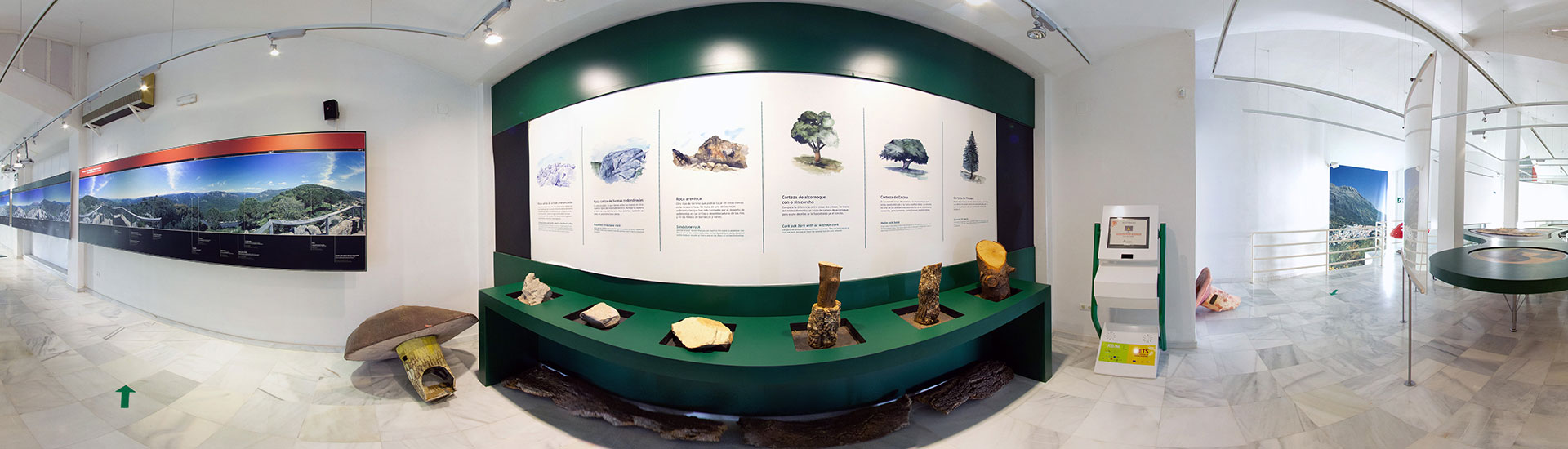
A través de la exposición interpretativa, el visitante podrá descubrir estos enclaves naturales, como sus paisajes, su naturaleza, su historia y sus gentes. De estos espacios naturales sorprende su gran diversidad y contraste, pero al mismo tiempo comparten numerosos elementos en común. El agua, por ejemplo, juega un papel fundamental en estos parques, configurando la morfología del paisaje y propiciando la supervivencia de formaciones forestales tan singulares y relictas, como los pinsapares de Sierra de las Nieves y Grazalema, o la laurisilva de Los Alcornocales.
A través de grandes panorámicas así como de elementos en tres dimensiones, se simula una rápida visita a cada uno de estos parques en la que observar sus peculiaridades. Tres puestos interactivos con un tapiz táctil conectado a una pantalla permiten realizar un viaje más en profundidad por estos territorios.
Landscape elements
The geology of these mountains is unique but not the same, their characteristics and soils give rise to different plant habitats being established on them. Through the sense of touch you will discover some hidden aspects of them.
Los Alcornocales Nature Reserve
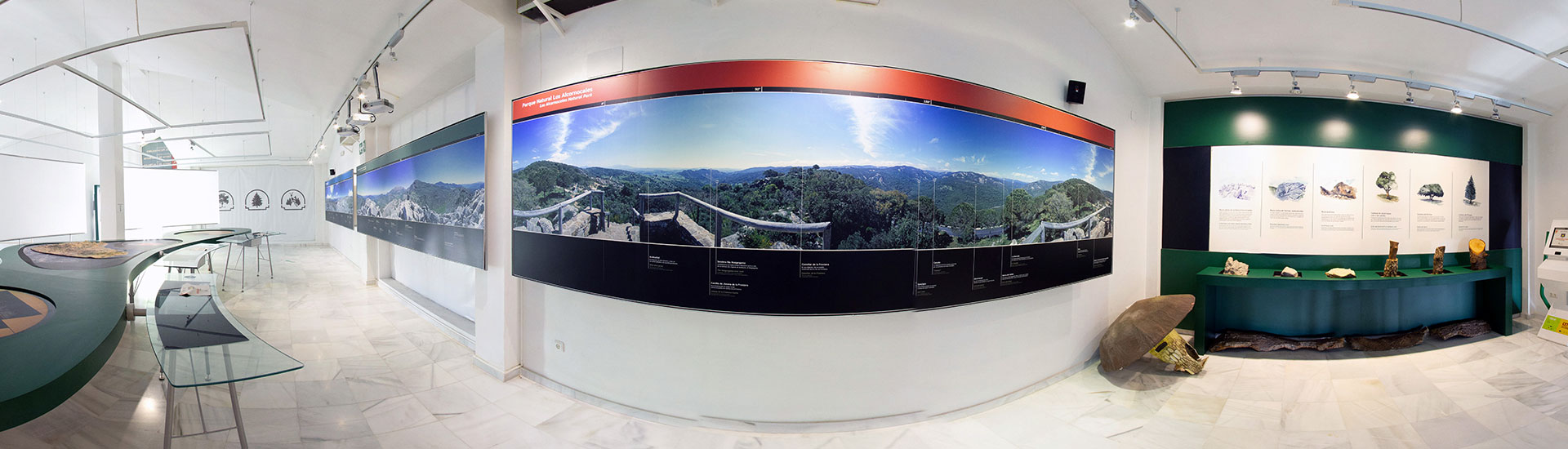
Located in the province of Cádiz and part of Málaga, it extends from the mountain range to the Estrecho Natural Park, displaying a great variety of reliefs and landscapes. Soil, moisture and traditional use have been the determining factors for maintaining the largest conserved and productive mass of cork oak in the Iberian Peninsula: Los Alcornocales Nature Reserve.
The main contributing factor for this richness is the water, present in numerous rivers, streams and reservoirs that, apart from supplying the province, are suitable for fishing and recreational activities. But above all, the humidity coming from the coast stands out, which accumulates forming cloud forests in narrow and deep valleys called canutos. In these conditions a very singular flora is conserved, belonging to the tertiary era: the laurel forest, which is characterised by smooth and bright leaves, taking advantage of the humidity and scarce light passing through the trees bordering the canutos. Thus, between the aroma of bay leaf, the beauty of the hornbeams in bloom, elegant laurel and holly, you can stroll through this type of jungle, accompanied by the sounds of the dipper, the skilful kingfisher and the warblers or finches, which hide among the ferns.
Hunting in these forests you can find, the booted eagle, short-toed eagle and buzzard, as well as the goshawks, sparrowhawks and tawny owls. Up high you can find mountain goats and numerous birds of prey, in particular the griffon vulture, the Egyptian vulture, Bonelli's eagle, night owl and peregrine falcon. In the lower grounds acebuchal (an ancient term for olive tree) has appeared in clay soil to make way for pasture to feed the cattle in the area, the Retinta cow. Among the Mediterranean scrub you can find roe deer, indigenous to the area and a symbol of big game, as well as the buck, deer and carnivores like genets, badgers and especially mongoose, with the largest population on the peninsula.
More information: lajunta.es/3p0v6
Sierra de Grazalema Natural Park
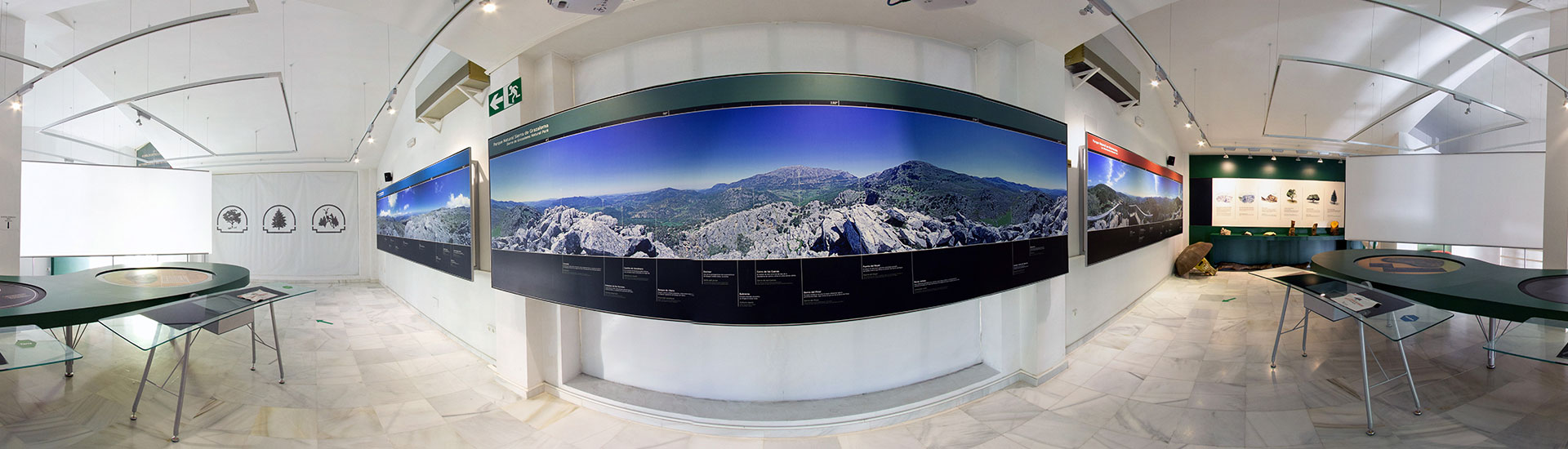
Straddled between Cádiz and Málaga it is formed of rugged mountains in which the erosion caused by the water has carved stunning gorges, such as the Garganta Verde or underground labyrinths of chasms and grottos among which the Hundidero-Gato complex stands out. It is the longest cave in Andalusia, noteworthy for providing a habitat to 100,000 bats, the largest population in Spain.
The most emblematic feature of the Park, apart from the dense Mediterranean forest of oaks, cork oaks and gall oaks, is the Spanish fir, concentrated mainly around the Sierra del Pinar mountains, as it is the rainiest region in the Peninsula. The conserved vegetation also gives rise to a rich fauna with deer, roe, rabbit, partridge and mountain goats finding sustenance from seeds, autumnal fruits and grass. The numerous birds stand out, such as the Bonelli's eagle and the griffon vulture, the latter has the largest colonies to be found in Europe here. Other emblematic carnivores, such as the genet and weasel, peregrine falcon, booted eagle and short-toed eagle, and night owl, complete the ecosystem.
More information: lajunta.es/3p0v8
Intercontinental Biosphere Reserve of the Mediterranean (Spain) - Morocco
Located at the dual crossroads of Europe and Africa, and between the Mediterranean and the Atlantic, it has unique natural conditions shared by both shores. Its physical and natural support are the mountains of the large and rugged Bético-Rifeña mountain range, which extends through Andalusia and Northern Morocco, with heights ranging from 2,170 metres at Jbel Lakraay to more than 500 metres of depth at the Strait of Gibraltar.
The Biosphere Reserve is an inviting territory for the visitor, because besides its rich landscape there is a charismatic socio-economic system typical of the mountain areas near the sea. They combine the traditional use of natural resources –linked to agriculture, cattle farming, fishing and forestry– with the possibilities of port communication and commercialisation. Historically and culturally, the area of the reserve responds to a history of neighbourliness and exchange that has determined its identity and way of life since Prehistory. For centuries, it maintained a character of frontier between the Christian and Muslim kingdoms, bearing as fruit the Andalusian culture, of which certain elements are maintained, such as a network of castles, for example, the ones at Chefchaouen, Castellar de la Frontera and Tarifa.
More information: lajunta.es/3p0v7
Sierra de las Nieves National Park
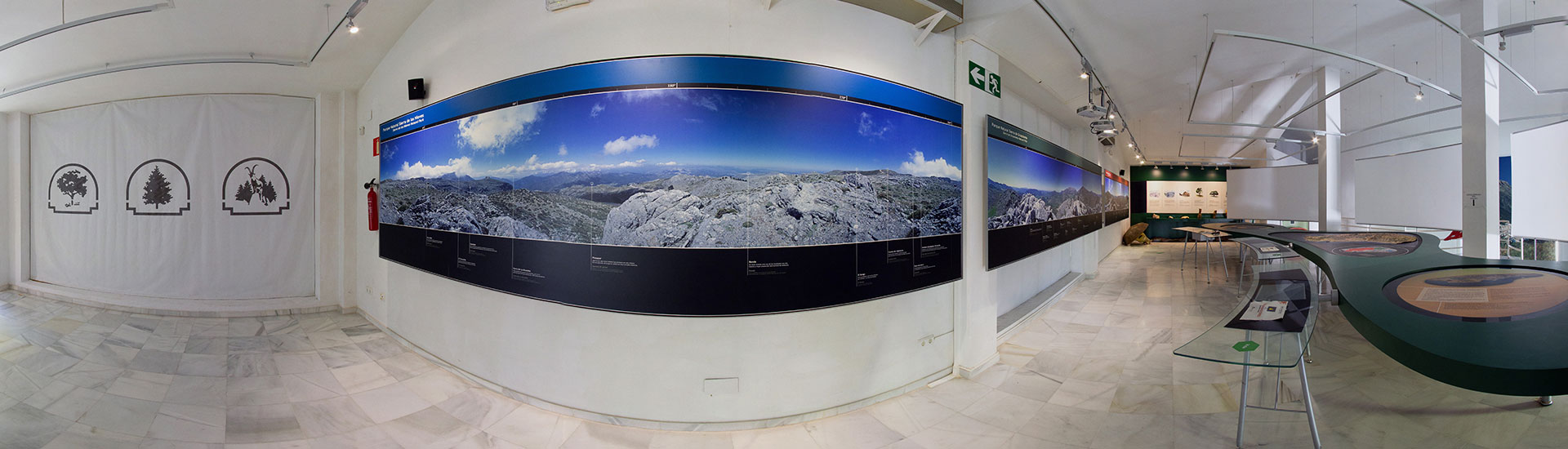
Whitish limestone formations are contrasted with steep red coloured hills in the Sierra de las Nieves National Park, located to the east of the city of Ronda (Malaga).
The name of the park reveals the presence of snow on its high peaks, which formerly remained there throughout the year. The locals stored it in the neveros (snow houses) and took advantage of the night-time to lower it by mules and distribute it to the towns and cities.
Another attraction of the mountains are the fir forests that survive in the interior. This Mediterranean fir is found in the cold and humid shaded areas; a botanical relic that dates back to the glacial period of the Peninsula. Today it is only found in this mountain range, in the Sierra de Grazalema and in Los Reales of Sierra Bermeja, the population of Sierra de las Nieves being the largest. Some of these trees are about 500 years old, such as the one at La Escalereta, declared a Natural Monument. Descending in height, the holm oaks and cork oaks of the mountains of Istán and Monda or some patches of carob trees and chestnut trees at Tolox and Parauta stand out.
The National Park provides shelter to mammals such as the mountain goat, easy to observe in the highest elevations. Other species of interest are roe deer and otter, present in its rivers. Among the birds, large raptors abound, such as the golden eagle, Bonelli's eagle, and the royal owl. Also those of the forests, such as the goshawk and the sparrowhawk.
More information: lajunta.es/3m739