Welcome

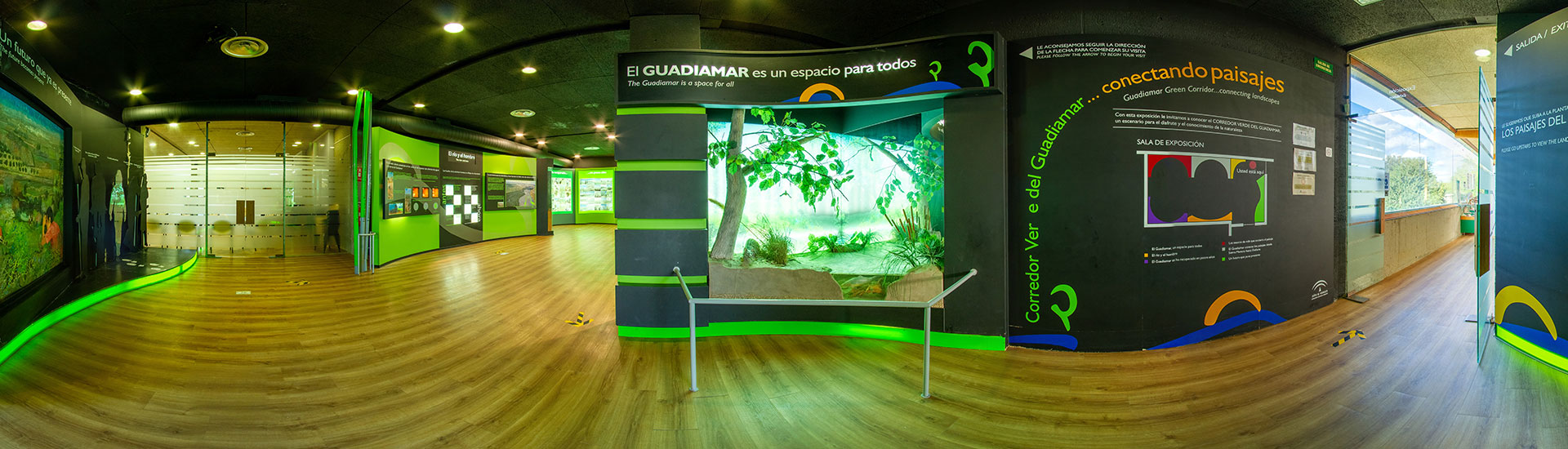
Welcome to the Guadiamar Visitor Centre located in the Guadiamar Green Corridor Protected Landscape, located in the municipality ofAználcazar, in the province of Seville. Here, you will be able to discover the assets of Guadiamar within the framework of the Network of Protected Natural Areas of Andalusia (RENPA).
In this centre, the visitor can find a central space where the reception and the Natural Space shop converge, where they will be attended to and where they will have the chance to buy a product or two related to the environment, and also an area with information about the Network of Protected Natural Areas of Andalusia (RENPA). The building also has a meeting, exhibition and events room, where an audiovisual on the merits of the Natural Space is also screened.
This Visitors Centre also has a cafeteria where you can recharge your batteries and an extensive outdoor recreation area where multiple outdoor activities connected to the Guadiamar River take place.
In these links you can find more information about this Protected Natural Area with downloadable material such as trails, opening hours, how to get there, map with all the facilities for public use, etc.
Guadiamar Visitor Center: lajunta.es/3p0ub
Guadiamar Green Corridor Protected Landscape: lajunta.es/3sq8o
Complete your visit with ecotourism experiences with local companies. You can consult the offer in the following link: ecoturismoandaluz.com
For activities aimed at the educational community, associations of people with functional diversity and local population, you can access through the link: reservatuvisita.ecoturismoandaluz.com
Guadiamar Green Corridor... Connecting its landscape and its inhabitants
The Guadiamar Green Corridor Protected Landscape was declared on 17 March 2015. It already has 17,013.00 hectares protected within the Sevillian municipalities of Onubenses de Aználcazar, Aználcollar, El Castillo de las Guardas, El Garrobo, Gerena, Huévar del Ajarafe, El Madroño, Nerva, Olivares, Sanlúcar la Mayor, Villamanrique de la Condesa and Zufre. It has its origin in the municipality of Castillo de las Guardas, in Sierra Morena. There, among holm oaks, it prepares for its way South, which you will discover in the first steps between areas of Mediterranean mountain and dehesas. Later on, you will see between fields of cereal crops and olive trees near the cornice of the region of Aljarafe, to little by little, get close to, between sands and pine forests, to the Sevillian marshlands of Doñana.
The Guadiamar connects the landscapes of the Sierra Morena mountains to Doñana
Sierra Morena is the king of the Mediterranean mountains which intermingles with farmlands of holm oaks and cork oaks, among those that open up to the freshness and life of the Guadiamar river banks. This great mosaic of nature, welcomes unique representatives of European fauna and flora turning this green corridor into a highway for wildlife.
Doñana: water, sand... and life
The marsh is a space without borders, surrounded by the mountains of coastal sands, where the pine trees in the groves, together with the Mediterranean scrub, fight incessantly with the sand. It is the last home of unique species to the European continent such as the Iberian lynx.
The future is already the present

A diverse mural represents the enormous diversity that currently houses this natural space, a mosaic of living landscapes that offers the opportunity of multiple ways to enjoy this Green Corridor along its more than 60 kilometres of signposted trail, which can be explored on foot, by bicycle, on horseback or even by boat.
The river and humans

Over thousands of years the exploitation of the land has not altered the territory too much. Ancestral cultures have used the riches offered by the waters and lands of the Guadiamar.
Mining, land for agriculture and livestock and water from the river, have all been used since days of old, as well as the mineral resources such as those exploited in the surroundings of the headwaters of the Guadiamar river. In recent times, however, human activities have radically transformed it. The abuse by man of these riches, especially since the 20th century, has damaged the Guadiamar river basin decisively.
The coexistence between nature and humans was broken in the early hours of 25 April 1998, when 6,000 million litres of poison stored in the Aznalcollar mineral waste basin, suddenly spilled into the Agrio River and the Guadiamar River, causing the destruction and pollution of the river life and the nearby fields All suffered tremendous damage -animals, vegetation and surrounding inhabitants- who had lived from the river from ancient times until then.
The Guadiamar has recovered in a few years

Since 25 April 1998, work has started to remove the sludge. The equivalent of almost 5,000 Olympic pools were extracted and more than 30,000 kilos of dead fish were collected.Thanks to the work of a great human team that provided solutions to that difficult scenario of contamination and destruction of life, this natural space has "recovered" in a few years. Its capacity for recovery has surprised all of society.
The treasures of life hidden in the landscape

Through the illustrated landscapes, the visitor can take a trip through the different sections of the Guadiamar Green Corridor, and discover how this not only weaves a richer landscape but provides concrete advantages that are very beneficial for society: they stop floods, provide refuge to species of ecological interest and host fauna allied to agriculture, fertilise the farmlands,...
The thickets and riverbanks, borders and hedges provide ecological health to the territory. In the Guadiamar basin, a long cultural and natural process has left us rich landscapes, where humans and nature coexist. Agriculture has shaped much of this landscape, transforming the part that would be occupied by Mediterranean vegetation, such as holm oaks, carob trees, mastic trees,...
The Guadiamar river continues to be a source of life today, because to speak of the Green Corridor is to speak of the river of princes, as the Arabs called it: Wadi-Amar.