



More than 200 activities in the return to the streets of The European Night of The Investigators
Scientific routes through the city, activities for children and schools and almost 200 activities in the tents on Paseo del Salón
The Night will close with the show Alfonso X el Sabio, which combines music, astronomy and history
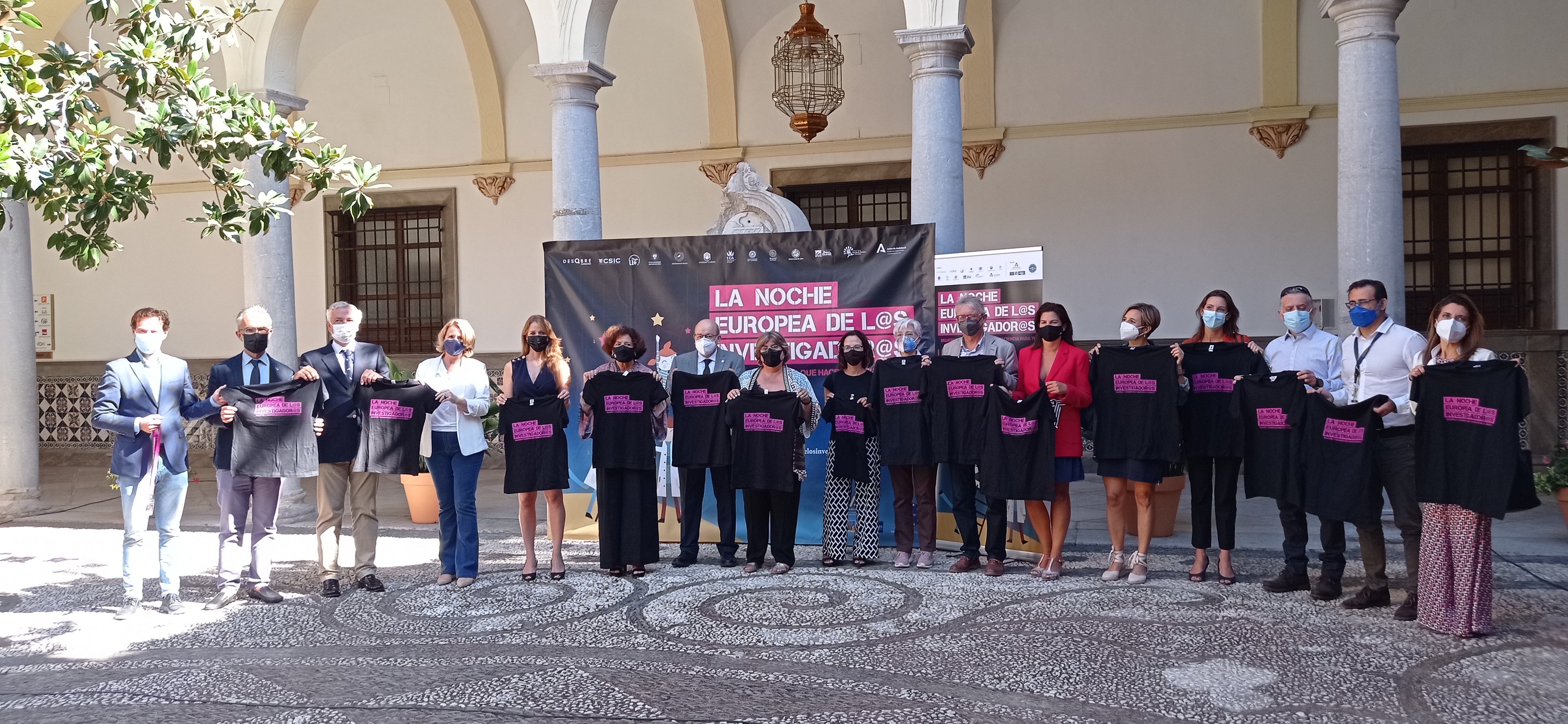
This morning the tenth consecutive edition of the European Researchers' Night was presented in Granada, which will take place on Friday, September 24 at the Paseo del Salón, and which will combine in-person and online activities.
Almost 200 activities to discover the most human side of research at the hands of the experts in the field themselves and through experiments, workshops, monologues, online meetings and scientific routes for all audiences.
Thus, after last year's online edition, the Paseo del Salón will once again be filled in 2021 with the traditional tents with activities. Starting at 5:00 p.m., children and adults will be able to enjoy talks and workshops prepared by almost 550 researchers - from sciences and humanities - from the city of Granada.
In addition, throughout Friday morning there will be activities aimed at schools in the province. And thanks to the participation of both the Granada Provincial Council and the La Caixa Foundation, workshops have also been organized for groups at risk of social exclusion and people with disabilities.
The scientific routes through the city also return, which this year include the Museum of Paleontology, the historical collection of the Zoology department of the Faculty of Sciences, several historical monuments, and a botanical tour of the gardens of the Zaidín Experimental Station (EEZ). -CSIC), among others.
The Night will close with the show Alfonso X El Sabio, which combines astronomy and science to the rhythm of music. A unique opportunity to see this show again, premiered at the Granada Early Music Festival.
The 2021 Night will conclude the next day, September 25, with a Mathematical Walk through the Alhambra and with a Flamenco activity in Carmen de la Victoria.
Presentation at the Town Hall
The presentation event, which took place at the Granada City Council, was chaired by Francisco Herrera, Councilor for Science, Innovation and Digital Transformation, Smart City, Infrastructure and Telecommunications, who stressed that “from the Granada City Council, as City of Science and Innovation, we are committed to promoting these activities and putting science back in the center of the capital. "That science permeates every corner, that young people visit the research centers again and that the University continues to lead the generation of talent that is then projected into the company and the city's economy," he added.
For her part, the rector of the University of Granada, Pilar Aranda, highlighted that “it is essential that people know what we do and how we do it. In this sense, "in recent times we have made a lot of progress; the fact that people know, for example, what a particle accelerator or a stem cell is influences how science is transforming the world." The rector has also highlighted that "science needs the interaction of all sciences, social, humanistic, legal, biochemistry or health, etc."
Likewise, the director of the School of Arab Studies, Mayte Penelas, (and who acted on behalf of the four CSIC centers participating in this event) highlighted that the CSIC participates in this “great event, which aims to bring science to society in a playful and simple way, for the tenth consecutive year.” Specifically, he has highlighted the more than forty activities, including micro-meetings, talks, workshops at the Kids Corner, tours of the Botanical Garden, in which "we will learn about pandemics, viruses or dust storms."
The director of the IAVANTE Line of the Progreso y Salud Foundation, Armando Romanos, has expressed the “relevance of organizing events of this type at a time when young people need references and to see, in this case, the science that is done near the areas where they live.” From the Foundation, "we have wanted with our activities, among other things, to turn boys and girls into surgeons for a day and show them how a surgical robot works."
For her part, the director of the Discover Foundation, Teresa Cruz, celebrated that this year “science returns to the streets” by betting on a hybrid format, with online and in-person activities, where presence has much more weight. For the director of Discover, “it is a pride to coordinate a project of this magnitude”, in which in this year's edition there are more than 700 activities planned throughout Andalusia. “For this edition we have adapted places to carry out safe activities under the Covid-19 protocol and we have delved deeper into the MonuMAI citizen science project, to which this year we added the collaboration with Tunisia,” Cruz detailed.
The territorial delegate of Employment, Training, Self-Employment, Economic Transformation, Industry, Knowledge and Universities in Granada, Virginia Fernández, pointed out that it is “a satisfaction for our institution to participate in a project of this magnitude, which allows knowledge to be transferred to the streets. and see how it affects our daily lives.” He also highlighted that it is “a special day because we return to in-person activities with more than one hundred in-person activities on the Paseo del Salón.” Science and research are necessary for society to advance,” he stressed.
A Granada, Andalusian... and European event
The European Researchers' Night is a European scientific dissemination project promoted since 2005 by the European Commission within the Marie Sktodowska-Curie actions of the Horizon 2020 program, which takes place simultaneously in more than 371 European cities in more than 30 countries. . In Andalusia alone, the activity involves almost 3,000 researchers who organize more than 700 activities.
In Granada, the organization is carried out by the University of Granada, the four CSIC centers that participate in this project (Institute of Astrophysics of Andalusia, School of Arab Studies, Institute of Parasitology and Biology López-Neyra and Estación Experimental del Zaidín) , the Progress and Health Public Foundation (through Biobanco and Genyo) and the City Council. The Andalusian School of Public Health, the Science Park, the Health Technology Park, the Biosanitary Research Institute of Granada (ibs.Granada), the Caja Granada Foundation and the European Documentation Center of Granada also participate in the Night. the UGR.
In addition, it is sponsored by the Provincial Council of Granada (and the Europe Direct program) and supported by the “La Caixa” Foundation, CaixaBank and the Spanish Foundation for Science and Technology (FECYT) of the Ministry of Science and Innovation. .
In Andalusia, the coordination of The European Night falls on the Discover Foundation, which leads a consortium of thirteen scientific institutions: the Ministry of Economic Transformation, Industry, Knowledge and Universities of the Junta de Andalucía, the nine public universities of Andalusia (Almería, Cádiz, Córdoba, Granada, Jaén, Huelva, Málaga, Seville and Pablo de Olavide), several centers of the Higher Council for Scientific Research in the community, the Progreso y Salud Public Foundation and the IMGEMA-Royal Botanical Garden of Córdoba.
At the same time, Radio Television of Andalusia, the Andalusian Institute for Agricultural, Fisheries, Food and Ecological Production Research and Training (IFAPA) and the Andalusian Knowledge Agency (AAC) are strategic partners of the project and collaborate closely in its development.
More information: lanochedelosinvestigadores.fundaciondecubre.es
Facebook: www.facebook.com/FundacionDiscover
Twitter: www.twitter.com/FDiscover and the hashtag #NIGHTspain
Youtube: www.youtube.com/user/fundaciondescubre
Instagram: www.instagram.com/fundaciondescubre